Table of Contents
Staying hydrated on the trail isn’t as simple as filling up at the nearest stream anymore. Whether you’re crushing miles on a remote backpacking route or logging vert during a trail race, the water you encounter could harbor everything from giardia to agricultural runoff. Modern outdoor athletes face a complex landscape of contamination risks that vary dramatically by region, season, and altitude. That’s why water filter bottles have evolved from simple gadgets into sophisticated pieces of safety equipment that deserve the same consideration as your footwear or navigation tools.
As we look toward 2026, the technology packed into these portable purification systems continues to advance at a remarkable pace. Today’s hikers and trail runners demand solutions that balance microbiological protection with practical trail weight, rapid flow rates with filter longevity, and rugged durability with sustainable materials. Understanding what separates a reliable field companion from a disappointing gadget requires digging into the engineering details that manufacturers don’t always advertise. This comprehensive guide walks you through the critical features, performance metrics, and decision factors that will help you identify the perfect filtration solution for your specific adventures.
Top 10 Water Filter Bottles for Hikers
Detailed Product Reviews
1. Katadyn BeFree 1.0L Water Filter, Fast Flow, 0.1 Micron EZ Clean Membrane for Endurance Sports, Camping and Backpacking, One Size, 8018006

Overview: The Katadyn BeFree 1.0L is a minimalist’s dream, combining a collapsible Hydrapak flask with a 0.1-micron hollow fiber filter. Weighing merely 2.3 ounces, it’s engineered for ultralight hikers, trail runners, and endurance athletes who prioritize weight savings and packability above all else. The system delivers fast-flowing, microbiologically safe water from natural sources.
What Makes It Stand Out: The BeFree’s revolutionary EZ-Clean membrane sets it apart—simply shake or swish in water to clean, eliminating tedious backflushing. Its Free Flow Channels achieve an impressive 2 liters per minute output, among the fastest in its class. The collapsible design compresses to pocket-size, making it uniquely suited for stuffing into running shorts or cycling jerseys where rigid bottles won’t fit.
Value for Money: Priced competitively for premium ultralight gear, the BeFree offers excellent value given its 1,000-liter filter lifespan and Swiss-engineered durability. While replacement filters cost extra, the two-year guarantee and lack of required accessories make it more economical than pump systems. It’s cheaper than the GRAYL GeoPress and comparable to LifeStraw’s squeeze systems.
Strengths and Weaknesses: Strengths: Exceptionally lightweight and packable; rapid flow rate; effortless cleaning; versatile for 1-2 people; durable construction. Weaknesses: Soft flask is less durable than hard bottles; 0.1-micron rating doesn’t remove viruses; limited to 1-liter capacity; requires careful handling to avoid punctures.
Bottom Line: Ideal for weight-conscious adventurers in backcountry zones where viruses aren’t a concern. Choose this for ultralight missions, but consider virus-capable alternatives for international travel.
2. Survimate 5-Stage 0.01μm Ultra-Filtration Filtered Water Bottle, BPA-Free Material, NSF/ANSI 42&372 Certified, Portable Water Filter Bottle for Survival, Camping, Hiking, and Emergency Use

Overview: The Survimate bottle integrates a sophisticated 5-stage filtration system into a portable 22oz bottle format, targeting survivalists and outdoor enthusiasts. Its 0.01-micron ultra-filtration membrane exceeds typical standards, while NSF/ANSI certifications validate its claims. The built-in compass reinforces its emergency-readiness positioning.
What Makes It Stand Out: The 0.01-micron pore size is significantly finer than most competitors’ 0.1-0.2-micron filters, capturing more contaminants including some viruses. The five-stage process—coarse screen, UF membrane, PP membrane, purification beads, and activated carbon—addresses heavy metals, chemicals, and odors that simpler filters miss. The integrated compass, while simple, adds genuine utility for navigation emergencies.
Value for Money: With a 1,500-liter filter lifespan and NSF certification, this bottle delivers premium performance at a mid-range price point. It effectively replaces 3,000 plastic bottles, offsetting its cost environmentally. While slightly pricier than basic LifeStraw bottles, the finer filtration and chemical reduction justify the premium for those prioritizing comprehensive protection.
Strengths and Weaknesses: Strengths: Superior 0.01-micron filtration; NSF certified; removes heavy metals and chemicals; built-in compass; long 1,500L lifespan; BPA-free construction. Weaknesses: Requires strong suction due to dense filtration; initial carbon dust requires priming; not dishwasher safe; compass durability concerns; heavier than squeeze-only systems.
Bottom Line: Excellent choice for emergency preparedness and international travel where water quality is questionable. Accept the suction effort for peace of mind from its thorough filtration.
3. LifeStraw Peak Series - Collapsible Squeeze Bottle Water Filter System – 650ml for Trail Running, Through Hiking, Travel, Cycling, and Fishing, Dark Mountain Gray

Overview: LifeStraw’s Peak Series reimagines their proven technology in a collapsible 650ml squeeze system optimized for fast-paced adventures. It protects against an extraordinary 99.999999% of bacteria and 99.999% of parasites and microplastics. The re-engineered membrane and included backwash accessory ensure sustained performance in silty conditions.
What Makes It Stand Out: The microfilter’s extreme removal rates exceed EPA standards by orders of magnitude, offering near-total biological protection. Its versatility shines—use as a squeeze bottle, straw, or connect to other Peak Series components for gravity-fed systems. The 2x thicker materials address previous durability complaints, creating an ultra-leak-proof system that withstands rugged use.
Value for Money: Priced similarly to the Katadyn BeFree but with enhanced durability and multi-modal functionality, it represents strong value. The 1,000-gallon (4,000L) filter lifespan dramatically outlasts most competitors. While the 650ml capacity is modest, the system’s adaptability effectively replaces multiple single-purpose filters, justifying its cost for serious adventurers.
Strengths and Weaknesses: Strengths: Exceptional pathogen removal rates; multiple usage modes; superior durability; effective backwash system; long filter life; microplastic filtration. Weaknesses: Smaller 650ml capacity; squeeze mechanism not ideal for all users; requires manual pressure; doesn’t improve taste or remove chemicals; no virus protection.
Bottom Line: Perfect for backcountry enthusiasts needing maximum biological protection in a packable format. Its versatility and durability make it a top-tier choice for multi-day wilderness trips.
4. LifeStraw Go Series Water Filter Bottle - BPA-Free, Removes Bacteria, Parasites, Microplastics, Improves Taste, 22oz, Aegean Sea

Overview: The LifeStraw Go Series merges the brand’s hallmark microfilter technology with a traditional rigid water bottle design, creating an everyday carry solution for travelers and commuters. The 22oz BPA-free bottle features both a membrane microfilter for pathogens and a carbon filter for taste improvement, addressing a broader range of contaminants than basic models.
What Makes It Stand Out: The dual-filter system distinguishes it from simpler squeeze bottles. The membrane tackles bacteria, parasites, and microplastics, while the carbon filter reduces chlorine, odors, and organic chemicals—crucial for urban tap water and travel. Its rigid construction feels familiar and secure, fitting standard cup holders and backpack pockets without the floppiness of collapsible designs.
Value for Money: With a membrane lasting 1,000 gallons and a competitive price point, it offers excellent long-term value for daily users. The carbon filter requires replacement every 26 gallons, adding modest ongoing costs. Compared to buying bottled water while traveling, it pays for itself within weeks. It’s more affordable than the GRAYL GeoPress while providing similar convenience.
Strengths and Weaknesses: Strengths: Dual filtration improves taste and safety; rigid bottle is durable and convenient; exceptional 1,000-gallon membrane life; easy to use; fits standard accessories. Weaknesses: Carbon filter needs frequent replacement; 22oz capacity may be insufficient for long hikes; doesn’t remove viruses; heavier than ultralight options; straw can be difficult to clean.
Bottom Line: The ultimate travel companion for international trips and daily urban use. Choose this for convenience and taste improvement, but bring backup capacity for extended backcountry outings.
5. GRAYL GeoPress 24 oz Water Purifier Bottle - Filter for Hiking, Camping, Survival, Travel (Black Camo)

Overview: The GRAYL GeoPress is a true water purifier, not just a filter, using a simple press mechanism to eliminate viruses, bacteria, protozoa, chemicals, and heavy metals. Its 24oz capacity and one-minute purification cycle make it ideal for international travelers and survivalists facing truly sketchy water sources where viral contamination is a real risk.
What Makes It Stand Out: Unlike most competitors, the GeoPress removes viruses—a critical distinction for developing countries and wilderness areas with human waste contamination. The press-action design requires no sucking, pumping, or waiting; just fill, press, and drink. It addresses the broadest contaminant spectrum, including PFAS, pesticides, and volatile organic compounds, making it a comprehensive purification solution.
Value for Money: While significantly more expensive than basic filters, the GeoPress justifies its price with true purification capabilities and unmatched speed. The 65-gallon cartridge life is shorter than some, but the breadth of protection is unparalleled. For travelers to virus-prone regions, it’s cheaper than medical bills and infinitely more reliable than iodine tablets.
Strengths and Weaknesses: Strengths: Removes viruses and comprehensive contaminants; incredibly fast and easy; no suction required; robust construction; excellent for international travel. Weaknesses: Shorter 65-gallon filter life; heavier and bulkier than ultralight options; higher initial cost; pressing requires firm effort; replacement cartridges are expensive.
Bottom Line: Essential for international travelers and emergency preppers who need virus protection. Accept the weight and cost for the confidence of true purification in the world’s most compromised water sources.
6. PHILIPS Water Bottle with Filter, Filter Water Bottle Stainless Steel with GoZero Everyday BPA-Free Tap Water Filter, Water Filter Bottle Keep Drink Cold 24 Hours, 1 Filter for 40 gal / 2 Months

Overview: The Philips GoZero Everyday filtered water bottle combines premium stainless steel construction with activated carbon filtration for urban hydration. This double-wall insulated bottle keeps drinks cold for 24 hours while improving tap water taste and odor through its integrated filter system designed specifically for municipal water sources.
What Makes It Stand Out: Philips leverages its brand reputation with a thoughtfully designed bottle featuring one-handed pop-up operation, a silicone mouthpiece for comfortable sipping, and top-rack dishwasher safety (excluding the filter). The built-in carry loop and cup-holder-friendly dimensions demonstrate genuine attention to daily convenience rarely seen in filtered bottles.
Value for Money: Positioned in the mid-range category, this bottle offers better insulation than most competitors and the reassurance of a trusted electronics brand. While the 40-gallon filter life matches Brita’s standard, the stainless steel construction and superior thermal performance justify the slight premium over plastic alternatives, delivering value for office workers and urban commuters.
Strengths and Weaknesses: Strengths include excellent temperature retention, leak-proof design, easy maintenance, and immediate taste improvement for municipal water. Weaknesses are the limited filtration scope—reducing only chlorine and particulates without addressing heavy metals or pathogens—and a filter lifespan that lags behind outdoor-focused alternatives, making it unsuitable for wilderness use.
Bottom Line: Ideal for commuters and gym-goers seeking better-tasting tap water in a durable, stylish package. However, international travelers and backcountry adventurers should look elsewhere for comprehensive pathogen protection.
7. LifeStraw Go Series — Insulated Stainless Steel Water Filter Bottle for Travel and Everyday Use Removes Bacteria, Parasites and Microplastics, Improves Taste, 1L Aegan Sea

Overview: The LifeStraw Go Series represents the gold standard for portable water filtration, removing bacteria, parasites, and microplastics from virtually any freshwater source. This insulated stainless steel bottle combines rugged construction with advanced two-stage filtration for confident hydration anywhere in the world, from airport bathrooms to mountain streams.
What Makes It Stand Out: The dual-filter system features a membrane microfilter lasting 1,000 gallons (5 years) that eliminates 99.999999% of bacteria and 99.999% of parasites, plus a carbon filter for taste improvement. This laboratory-grade protection in a consumer bottle is unprecedented, making it genuinely suitable for international travel and backcountry use where water quality is unknown.
Value for Money: While priced at a premium, the five-year membrane lifespan delivers exceptional long-term value. Eliminating 8,000 plastic bottles and countless water-borne illness risks justifies the investment for serious travelers. The dual-filter approach balances protection with palatability, though frequent carbon replacements add ongoing costs.
Strengths and Weaknesses: Strengths include unparalleled pathogen removal, durable insulation, and genuine versatility across use cases. Weaknesses involve the shorter carbon filter lifespan (26 gallons), higher replacement costs, and potential over-engineering for users only needing basic chlorine reduction from municipal supplies.
Bottom Line: An essential tool for international travelers, hikers, and anyone accessing questionable water sources. For pure tap water improvement, it’s overkill, but for true water security, nothing else matches its capabilities in this convenient form factor.
8. Survimate 5-Stage 0.01μm Ultra-Filtration Filtered Water Bottle, BPA-Free Material, NSF/ANSI 42&372 Certified, Portable Water Filter Bottle for Survival, Camping, Hiking, and Emergency Use
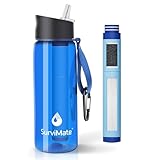
Overview: The Survimate bottle targets outdoor enthusiasts with its impressive 5-stage filtration system featuring a 0.01-micron UF membrane. NSF/ANSI certified for chlorine and lead reduction, this BPA-free bottle delivers laboratory-validated performance for camping, hiking, and emergency preparedness scenarios where water quality is unpredictable and potentially hazardous.
What Makes It Stand Out: The ultra-fine 0.01-micron filtration surpasses most competitors, removing 99.99% of harmful substances including heavy metals and microscopic contaminants. The integrated compass adds genuine survival utility, while the 1,500-liter filter lifespan replaces approximately 3,000 plastic bottles, demonstrating environmental consciousness for eco-minded adventurers who prioritize both safety and sustainability.
Value for Money: Positioned as a mid-range outdoor option, it offers superior filtration precision and certification compared to similarly priced bottles. The extended filter life reduces replacement frequency, making it economical for regular adventurers despite the initial investment. For occasional campers, the specialized features may exceed practical needs but provide peace of mind.
Strengths and Weaknesses: Strengths include exceptional filtration fineness, NSF certification, built-in navigation aid, and impressive longevity. Weaknesses encompass the non-dishwasher-safe construction, required strong suction due to dense filtration layers, and initial carbon particle discharge that necessitates discarding the first few sips—a minor but notable inconvenience during setup.
Bottom Line: A reliable companion for serious hikers and campers prioritizing water safety. The compass and robust filtration justify the minor inconveniences. However, urban users will find the suction effort excessive for simple tap water improvement.
9. Sawyer Products SP128 Mini Water Filtration System, Single, Blue

Overview: The Sawyer MINI redefines portable filtration with its palm-sized 0.1-micron absolute filter weighing just 2 ounces. Designed for minimalist adventurers, this versatile system attaches to included squeeze pouches, standard disposable bottles, hydration packs, or functions as a straw for direct source drinking, making it indispensable for hiking, international travel, and emergency preparedness kits where weight and space are critical.
What Makes It Stand Out: Each unit undergoes individual triple-testing to guarantee performance, removing 99.99999% of bacteria and 99.9999% of protozoa. The staggering 100,000-gallon filter lifespan essentially makes it a lifetime investment, while universal 28mm threading ensures compatibility with countless containers, eliminating proprietary limitations.
Value for Money: At a budget-friendly price point with virtually unlimited filtration capacity, the MINI delivers unmatched economic value. The included cleaning plunger maintains flow rates indefinitely, eliminating replacement costs and making it the most cost-effective solution for serious outdoor use over years of adventures.
Strengths and Weaknesses: Strengths include unparalleled portability, extraordinary longevity, versatile deployment options, and proven reliability in field conditions across developing nations and wilderness areas. Weaknesses involve the lack of insulation, requirement for active squeezing or sucking, and absence of carbon filtration for taste improvement, making it less convenient for casual daily sipping compared to integrated bottle designs.
Bottom Line: An essential, no-compromise tool for ultralight backpackers and preparedness advocates. While not a conventional water bottle, its filtration performance and durability are unmatched. Urban users should consider integrated bottle designs for convenience.
10. Brita Stainless Steel Premium Filtering Water Bottle, BPA-Free, Reusable, Insulated, Replaces 300 Plastic Water Bottles, Filter Lasts 2 Months or 40 Gallons, Includes 1 Filter, Stainless - 20 oz.

Overview: Brita’s stainless steel filtered bottle brings the brand’s familiar carbon filtration to an insulated, portable format. This 20-ounce bottle targets everyday users seeking to improve tap water taste while reducing single-use plastic consumption, maintaining cold temperatures for 24 hours through double-wall construction and replacing up to 300 disposable bottles per filter.
What Makes It Stand Out: The easy-sip straw design, one-handed push-button lid, and integrated carrying loop prioritize convenience for gym sessions and commutes. Brita’s widespread retail presence ensures filter availability virtually anywhere, while the leak-proof construction prevents bag disasters and the stainless steel body resists daily wear and tear.
Value for Money: Competitively priced against similar insulated filtered bottles, it delivers consistent performance for municipal water improvement. The two-month replacement cycle aligns with typical usage patterns, though filter costs accumulate over time. The Brita name commands trust but doesn’t necessarily outperform generic alternatives in filtration capability.
Strengths and Weaknesses: Strengths include trusted brand recognition, effective chlorine reduction, excellent insulation, and user-friendly operation that requires minimal learning curve. Weaknesses comprise basic filtration limited to taste/odor improvement, inability to handle untreated water sources, and a 20-ounce capacity that may require frequent refilling for active users or hot climates.
Bottom Line: A reliable, mainstream choice for improving municipal water taste in daily routines. Perfect for office workers and fitness enthusiasts who prioritize convenience. Those needing pathogen removal or larger capacities should explore alternative options better suited to their specific requirements.
Understanding Water Filter Bottle Technology for Outdoor Adventures
Mechanical Filtration Systems
Mechanical filtration works like an ultra-fine sieve, physically blocking pathogens and particles from passing through. Most outdoor bottles use hollow fiber membranes with pore sizes measured in microns—typically 0.1 or 0.2 microns for bacteria and protozoa removal. The technology relies on creating a tortuous path that traps microorganisms while allowing water molecules to pass. Understanding the membrane construction helps you evaluate real-world performance, as fiber density and surface area directly impact both flow rate and clogging resistance.
Activated Carbon and Chemical Filtration
Carbon elements address taste, odor, and chemical contaminants that mechanical filters miss. The activation process creates millions of microscopic binding sites that adsorb chlorine, pesticides, and some heavy metals. For trail runners near agricultural areas or hikers encountering treated water sources, this secondary stage becomes crucial. However, carbon has a finite capacity—once binding sites fill, contaminants pass through, making replacement scheduling critical for consistent protection.
UV Purification Integration
Emerging designs incorporate UV-C LED technology as a final sterilization step, particularly valuable for virus protection in international travel or heavily trafficked areas. These systems require battery power and clear water to function effectively, as UV can’t penetrate sediment. The combination of mechanical filtration plus UV creates redundancy that appeals to risk-averse adventurers, though it adds weight and complexity.
Gravity-Fed vs Squeeze-Fed Mechanisms
Your drinking style determines which mechanism suits your activity. Squeeze-fed systems require manual pressure to force water through the filter, offering faster hydration but demanding hand strength. Gravity-fed designs let you fill and hang the bottle, drinking through a straw as filtration happens passively. Trail runners typically prefer squeeze systems for quick sips during effort, while hikers on leisurely treks might favor gravity’s ease.
Key Features That Matter for Hikers and Trail Runners
Flow Rate and Sipping Resistance
Nothing kills momentum like struggling to get water through a clogged filter. Quality systems deliver 1-2 liters per minute with minimal suction force. Look for specifications on initial flow rate and how it degrades over the filter’s lifespan. Some designs incorporate bypass valves or pre-filters that maintain drinkability even as the main filter approaches end-of-life.
Weight and Packability Considerations
Every ounce matters when you’re counting grams for a fastpacking trip or ultra-distance race. Premium bottles designed for trail running often weigh under 8 ounces empty, while more robust hiking models might reach 12-16 ounces. Consider whether the bottle fits standard pack pockets and how it carries when attached externally. Collapsible designs offer packability but may sacrifice durability.
Filter Lifespan and Replacement Indicators
Most filters process 250-1,000 liters before replacement, but this varies dramatically based on water quality. Clear indicators—whether electronic alerts or mechanical flow restrictors—prevent drinking on an expired filter. Calculate your typical usage: a weekend warrior might get two years from a filter, while a thru-hiker could exhaust one in a single season.
Material Durability and BPA-Free Construction
Tritan copolyester dominates high-end bottles for its shatter resistance and chemical stability, though some athletes prefer stainless steel for taste neutrality. Ensure all components are BPA, BPF, and BPS-free. Check impact ratings and whether the manufacturer warranties against cracks from drops—a common failure point at filter connections.
Capacity and Size Options for Different Trail Demands
Single-Serve Personal Bottles
16-20 ounce bottles suit trail runners and day hikers on routes with frequent water sources. These compact designs prioritize hand-feel and fit in running vest pockets. The trade-off is more frequent stops, which some athletes actually prefer for pacing. Consider your personal hydration rhythm and whether you mind pausing to refill every hour.
Extended Day Hike Capacities
24-32 ounce models balance carry weight with fewer refill stops, ideal for desert hiking or routes with 5+ mile water gaps. These bottles typically feature more robust construction and larger filter elements that maintain flow despite higher volume demands. The increased size may require dedicated bottle pockets or external carry systems.
Ultra-Lightweight Running Designs
Sub-6 ounce minimalist bottles sacrifice some durability and filter lifespan for pure speed. They often use smaller diameter filters that clog faster but are easier to replace in the field. These designs pair well with collapsible backup reservoirs for long stretches between reliable sources.
Contaminant Protection Levels Explained
Removing Bacteria and Protozoa
In North American backcountry, bacteria like E. coli and protozoa such as Giardia and Cryptosporidium pose the primary threats. A 0.2-micron mechanical filter handles these effectively. Verify NSF/ANSI 42 and 53 certifications, which validate manufacturer claims. Remember that cold water and high sediment loads can reduce log-reduction performance in real conditions.
Virus Protection: When You Need It
Standard outdoor filters don’t remove viruses due to their tiny size. If you travel internationally or hike in areas with poor sanitation, you need either a purifier (0.02 micron or smaller), chemical treatment, or UV. Many 2026 models offer virus-capable cartridges you can swap in for specific trips, providing flexibility without carrying unnecessary weight.
Handling Sediment and Turbidity
Murky water clogs filters rapidly and harbors contaminants. Pre-filters—removable mesh screens or sediment discs—extend main filter life dramatically. Some advanced bottles feature graduated filtration stages that separate large particles before they reach the microporous membrane. Always carry a bandana or coffee filter as a backup pre-filter for extremely turbid sources.
Chemical and Heavy Metal Reduction
Agricultural runoff introduces nitrates, pesticides, and herbicides that carbon filters address partially. Heavy metals from mining operations require specialized ion-exchange media rarely found in portable bottles. Research your typical trail regions—if you frequent areas with industrial contamination, you may need a more robust system than standard backcountry models provide.
Ergonomics and Usability on the Move
One-Handed Operation Features
Trail runners need to drink without breaking stride. Look for flip-top caps that open with thumb pressure, squeeze triggers that don’t require two hands, and mouthpieces that seal automatically between sips. The best designs let you hydrate from a vest pocket without removing the bottle.
Carrying Options and Clip Points
Integrated carry loops, carabiner holes, and textured grip zones matter more than you’d think. Bottles that clip securely to pack straps free up pocket space. Some designs feature modular attachments that convert between handheld running mode and pack-mounted hiking configuration.
Mouthpiece Design and Hygiene
Bite valves collect bacteria and mold if not cleaned regularly. Choose designs with minimal crevices and dishwasher-safe components. Flip-up spouts with protective covers prevent trail dirt from contaminating the drinking surface. Consider whether you prefer wide-mouth openings for easy refilling or narrow spouts for controlled flow.
Maintenance in the Field
Backflushing and Cleaning Procedures
Every filter requires periodic backflushing to clear trapped particles. The best bottles include integrated syringes or squeeze bulbs that make this a 30-second trail-side task. Learn the recommended frequency—typically every 5-10 liters in clear water, more often in sediment-heavy sources. Neglecting this dramatically shortens filter life.
Storing Your Filter Between Adventures
Never store a filter wet for extended periods. Dry it completely after each trip, or store it wet with a preservative solution if the manufacturer recommends it. Freezing temperatures destroy wet filters by expanding water inside the membrane fibers. Some 2026 models feature freeze-resistant designs, but prevention remains the best strategy.
Troubleshooting Common Issues
Reduced flow usually means it’s time to backflush or replace. Leaks at seals often indicate worn O-rings—carry spares. Strange tastes suggest carbon exhaustion or bacterial growth in the bottle itself. Unusual resistance when squeezing can signal airlock; try loosening the cap slightly to equalize pressure.
Performance in Challenging Conditions
Freezing Temperature Precautions
Below 32°F, water inside filter membranes expands and ruptures fibers. Keep your bottle in a sleeping bag at night and close to your body during the day. Some manufacturers offer insulated sleeves, but these add bulk. If freezing is unavoidable, switch to chemical treatment or boil water instead.
High-Sediment Water Sources
Desert potholes and glacial melt demand extra pre-filtration. Let water settle in a separate container before filtering. Wrap a coffee filter around the intake straw. Some advanced bottles feature sediment-disc attachments that screw onto the filter inlet specifically for these conditions.
Altitude Considerations
High altitude increases UV intensity, potentially degrading plastic components faster. The lower boiling point of water at elevation makes filters more critical since you can’t rely on boiling alone. Air pressure differences can cause leaks in poorly sealed systems, so test your bottle before committing to a high-altitude expedition.
Cost Analysis and Long-Term Value
Initial Investment vs Replacement Costs
Premium bottles command $80-150 upfront but often prove cheaper over time. Calculate the cost-per-liter: a $100 bottle with a 500-liter filter costs $0.20 per liter, while a $40 bottle with a 100-liter filter costs $0.40 per liter. Factor in how many replacement cartridges you’ll need annually based on your usage patterns.
Warranty and Manufacturer Support
Lifetime warranties signal confidence but read the fine print—many exclude filters as consumables. Check whether the company offers pro deals for outdoor professionals or loyalty discounts on replacements. Responsive customer service matters when you’re troubleshooting a failed filter mid-trip.
Calculating Cost-Per-Liter
Track your actual water consumption on typical trips. A weekend warrior drinking 3 liters per day on 20 annual trail days processes 60 liters yearly. A thru-hiker covering 2,000 miles might filter 300+ liters in one season. Your usage determines whether a long-life filter justifies its higher price.
Environmental Impact and Sustainability
Reducing Single-Use Plastic Waste
A quality filter bottle eliminates hundreds of disposable bottles annually. Calculate your personal impact: if you buy two disposable bottles per trail day, 50 days equals 100 bottles diverted from landfills. The manufacturing footprint of one reusable bottle is offset within months of regular use.
Recyclable Filter Components
Traditional filters combine multiple materials that can’t be separated for recycling. Newer designs use mono-material construction or feature replaceable filter elements where only the membrane gets discarded. Some manufacturers offer take-back programs for used cartridges, though availability remains limited.
Carbon Footprint Considerations
Filter production is energy-intensive, but still generates less CO2 than manufacturing and transporting equivalent bottled water. Stainless steel bottles have higher initial production emissions than plastic but last longer. Consider the full lifecycle—durability matters as much as material choice.
Future Innovations on the Horizon for 2026
Smart Technology Integration
Bluetooth-enabled bottles that track filter life, water consumption, and even basic water quality metrics are entering the market. These systems alert your phone when it’s time to backflush or replace, removing guesswork. The technology adds minimal weight but requires charging, a trade-off for data-driven athletes.
Improved Filter Materials
Graphene-enhanced membranes promise higher flow rates and longer life in the same footprint. Bio-based plastics derived from algae or agricultural waste reduce petroleum dependence. Self-cleaning coatings that prevent biofilm buildup could eliminate backflushing entirely.
Multi-Function Designs
Bottles that convert into gravity-fed camp systems, integrate with hydration bladders, or feature modular caps that accept different filter types for varying contamination levels represent the next evolution. The goal is one system that adapts from trail running to international travel without buying multiple bottles.
Frequently Asked Questions
How do I know when my filter needs replacing? Most bottles show reduced flow rate as the primary indicator. Some include mechanical indicators that change color or lock when the filter reaches capacity. Track your usage in liters and replace at the manufacturer’s recommended maximum, even if flow seems acceptable. Using an expired filter provides false security.
Can I filter salt water or urine with these bottles? No. Standard portable filters cannot desalinate water or remove dissolved solids. They only remove particulates and microorganisms. For salt water, you need a reverse osmosis system. For emergency hydration, specialized desalination tablets exist, but they’re not practical for regular trail use.
What’s the difference between a filter and a purifier? Filters remove bacteria and protozoa mechanically. Purifiers also eliminate viruses, typically through smaller pores (0.02 microns), chemical treatment, or UV. In North American wilderness, a filter usually suffices. For international travel or areas with human waste contamination, use a purifier.
How should I clean my bottle between trips? Disassemble completely and wash all non-filter components with warm soapy water. For the filter itself, follow manufacturer instructions—some can be backflushed with clean water, others require special storage solution. Never use bleach or harsh chemicals that could damage filter membranes. Air dry thoroughly before reassembly.
Do I need to filter clear mountain spring water? Yes. Even pristine-looking water can contain Giardia from wildlife feces upstream. Visual clarity doesn’t guarantee microbiological safety. The only exception is water emerging directly from a spring where you can see the source underground. When in doubt, filter.
Can I use my filter bottle for everyday tap water? Absolutely, and this extends filter life by reducing sediment load. However, carbon elements will exhaust faster from chemical removal. If your primary use is municipal water, consider a bottle with replaceable carbon specifically designed for taste improvement rather than backcountry filtration.
What happens if my filter freezes? Ice crystals rupture the hollow fiber membranes, creating holes that allow pathogens through. A frozen filter is ruined and must be replaced. Prevention is critical: sleep with your bottle, use insulation, or switch to chemical treatment in sub-freezing conditions. Some manufacturers offer freeze-testing warranties.
How do I handle water with algae or chemical smells? Pre-filter through a cloth to remove algae chunks. Activated carbon helps with odors and some chemical tastes, but severe contamination requires a specialized filter. If water smells strongly of chemicals or fuel, don’t drink it—no portable filter reliably removes petroleum products or industrial solvents.
Are there any water sources I should absolutely avoid? Avoid water downstream from heavy industry, mining operations, or concentrated agricultural runoff. Also steer clear of water with visible chemical sheens, strong sulfur smells, or radioactive area warnings. No portable bottle can make severely contaminated industrial waste safe.
Can children use these bottles effectively? Most designs require significant squeeze pressure or suction that young children can’t generate. Look for models specifically marketed for family use with easier flow rates. Always supervise children and ensure they understand not to drink unfiltered water if the bottle malfunctions. Some brands offer kid-sized versions with appropriately scaled filtration.
Related Buying Guides
- 10 Essential Water Filter Bottles Every Day Hiker Needs in 2026
- The 10 Best Water Filter Straws for Hikers in 2026
- 10 Best Water Purifiers for Hikers Facing Contaminated Streams in 2026
- We Tested 50 Portable Water Filters - Here are the 10 Best for Solo Hikers
- 10 Best Alcohol Stoves for Ultralight Hikers This Year