Table of Contents
When the temperature plummets, visibility drops to near zero, and every decision carries weight, your knife isn’t just a tool—it’s your lifeline. For survivalists venturing deep into the untamed wild, the difference between a manageable situation and a critical failure often hinges on the reliability of that single piece of steel at your side. Forget the flashy marketing or the “trendy” gear showcased online; true survival demands a hunting knife engineered for brutality, simplicity, and unwavering function when modern conveniences vanish. Choosing the wrong blade isn’t an inconvenience; it’s a potentially dangerous miscalculation.
Too many buying guides drown you in specs for tactical folders or focus solely on trophy prep, ignoring the raw, multi-faceted demands of prolonged wilderness survival. A genuine survival hunting knife must seamlessly transition from field dressing game at dawn to batoning firewood in a downpour, then carve shelter components as night falls—all without chipping, snapping, or slipping in a gloved hand. This guide cuts through the noise, focusing exclusively on the non-negotiable features and design philosophies that define a true survival hunting companion. We’ll dissect what actually matters when your life depends on it, moving beyond aesthetics to the core engineering that ensures your blade becomes an extension of your will in the wild.
Top 10 Hunting Knives for Survivalists
Detailed Product Reviews
1. Cold Steel Drop Forged Survivalist 8" 52100 High-Carbon Steel Clip Point Fixed Blade EDC Tactical Hunting Utility Knife, 5" Ergonomic Handle, Weather-Resistant Secure-Ex Sheath

Overview:
This robust fixed-blade knife is engineered for demanding survival and tactical scenarios. Forged from a single piece of 52100 high-carbon steel, it features an 8" clip-point blade with a 5.5mm thickness, a 5" ergonomic handle, and a versatile Secure-Ex sheath. Designed for resilience in harsh conditions, it targets hunters, bushcrafters, and emergency preparedness enthusiasts.
What Makes It Stand Out:
The drop-forged 52100 steel construction delivers exceptional toughness and edge retention, outperforming many stainless-steel alternatives. The full-tang design ensures structural integrity, while the Secure-Ex sheath offers unparalleled carry flexibility—belt, neck, or pack-lashed. The ergonomic handle and integrated steel guard enhance safety during heavy-duty tasks.
Value for Money:
Priced premium for its forged steel and sheath system, it justifies cost through longevity and adaptability. While cheaper stainless knives exist, they often lack the durability for sustained abuse. This knife competes favorably with high-end brands like ESEE, offering superior edge-holding for survival-centric users.
Strengths and Weaknesses:
Strengths: Unmatched durability from forged carbon steel; versatile Secure-Ex sheath; secure grip; excellent for chopping and batoning.
Weaknesses: High maintenance (prone to rust without care); heavy at 18.3oz; sheath retention can loosen over time.
Bottom Line:
Ideal for serious survivalists prioritizing durability over weight savings. Its maintenance demands make it less suited for casual users, but for rugged outdoor tasks, it’s a reliable workhorse worth the investment.
2. Mossy Oak Survival Hunting Knife with Sheath, 15-inch Fixed Blade Tactical Bowie Knife with Sharpener & Fire Starter for Camping, Outdoor, Bushcraft

Overview:
This 15" fixed-blade Bowie knife combines a 10" stainless-steel blade with practical survival extras. Featuring a rubber handle, nylon sheath, and included fire starter/sharpener, it targets campers and hunters seeking an all-in-one outdoor tool at an accessible price point.
What Makes It Stand Out:
The package includes essential survival add-ons—fire starter and sharpener—rare at this price tier. The stainless-steel blade offers rust resistance and decent edge retention, while the rubber handle ensures a non-slip grip in wet conditions. The saw-back spine adds utility for wilderness tasks.
Value for Money:
An excellent budget option for beginners. The included accessories eliminate initial add-on costs, though the blade steel (generic stainless) is mid-tier. Competes with entry-level knives from brands like Morakniv but falls short of premium carbon-steel knives in performance.
Strengths and Weaknesses:
Strengths: Affordable with survival extras; rust-resistant stainless steel; comfortable rubber grip; lightweight at 16.8oz.
Weaknesses: Blade steel lacks high-end sharpness/edge retention; sheath quality feels flimsy; fire starter/sharpener are basic.
Bottom Line:
A solid starter knife for casual campers or as a bug-out bag addition. Not for heavy bushcrafting, but its value-packed kit makes it a smart pick for budget-conscious adventurers.
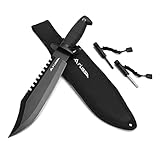
3. FLISSA Survival Hunting Knife with Sheath, 15-inch Full Tang Fixed Blade Tactical Bowie Knife with Sharpener & Fire Starter for Camping, Outdoor, Bushcraft
Overview:
Mirroring the Mossy Oak model closely, this 15" full-tang Bowie knife features a 10" stainless-steel clip-point blade, rubber handle, and nylon sheath. It includes a fire starter and sharpener, positioning itself as a versatile gift for outdoor enthusiasts.
What Makes It Stand Out:
Identical in specs to Product 2, its differentiation lies in marketing as a “gift for men.” The black-anodized blade and saw-back spine enhance utility, while the full tang provides solid backbone for light chopping. The sheath’s belt-hanging system aids accessibility.
Value for Money:
Priced similarly to the Mossy Oak, it offers comparable value—good for novices but not specialists. The included tools add convenience, though their quality is functional, not exceptional. Lacks the premium feel of Gerber or Cold Steel.
Strengths and Weaknesses:
Strengths: Full tang for strength; non-slip rubber handle; complete survival kit (fire starter/sharpener); ideal as an affordable gift.
Weaknesses: Generic stainless steel limits edge performance; sheath durability concerns; redundant features vs. Product 2.
Bottom Line:
Choose this over Product 2 only for gifting appeal. It’s a competent entry-level knife but doesn’t innovate beyond basic survival needs—best for teens or casual users.
4. Gerber Gear Ultimate Survival Knife, Fixed Blade Knife with Combo Edge, includes Fire Starter Edge and Ferro Rod, Whistle, Sheath with Integrated Sharpener - Bushcraft, Hunting and Camping Tool

Overview:
Gerber’s 10" fixed-blade survival knife integrates multiple tools into one compact package: a 4.8" combo-edge blade, ferro rod, whistle, and sheath with built-in sharpener. Designed for minimalist adventurers, it emphasizes versatility without excessive bulk.
What Makes It Stand Out:
The sheath is revolutionary—housing a ferrocerium rod, sharpening stone, and secure blade retention. The textured rubber grip ensures control in adverse conditions, while the hammer pommel doubles as an emergency tool. The half-serrated blade balances slicing and rugged tasks.
Value for Money:
Priced mid-to-high, it delivers exceptional utility density. Competitors often sell these features separately, making Gerber’s all-in-one solution cost-effective for survivalists. Durability matches Gerber’s reputation, backed by a lifetime warranty.
Strengths and Weaknesses:
Strengths: Sheath-integrated survival tools; reliable 440C stainless steel; lightweight (11.02oz); ergonomic grip; comprehensive warranty.
Weaknesses: Shorter blade limits heavy-duty use; ferro rod storage is awkward; sharpener quality is modest.
Bottom Line:
The top choice for hikers prioritizing compact, multi-functional gear. Its thoughtful design justifies the price, though hardcore bushcrafters may prefer larger blades.
5. Hunting Knife with Sheath Survival Knives for Men - Best Tactical Camping Hunting Hiking Knife - Bushcraft Field Gear Accessories Tool - Fixed Blade Sharp Knofe with Rubber Handle for Men 148109

Overview:
A compact 8.8" fixed-blade knife with a 4.4" 440C stainless-steel blade and rubber handle. Marketed heavily as a gift, it includes a Cordura sheath and targets casual hunters, hikers, and gift shoppers seeking an affordable, no-frills tool.
What Makes It Stand Out:
Its petite size and lightweight design (exact weight unspecified but implied light) suit EDC or light-duty tasks. The satin-finished 440C steel offers decent corrosion resistance, and the Cordura sheath provides basic belt carry. Strong gifting angle with holiday-focused marketing.
Value for Money:
The lowest-priced option here, ideal for infrequent use. While 440C steel is entry-level, it’s adequate for slicing and skinning. Lacks the survival extras of Products 2–4, making it purely a utility knife rather than a survival tool.
Strengths and Weaknesses:
Strengths: Compact and portable; rust-resistant steel; comfortable rubber grip; excellent gift presentation.
Weaknesses: Too small for survival/bushcraft; sheath lacks durability; no fire starter/sharpener; blade thickness (implied thin) limits heavy tasks.
Bottom Line:
A passable everyday carry knife for light chores or as a stocking stuffer. Avoid for serious survival use—opt for Products 1 or 4 instead—but a safe gift for casual outdoorsmen.
6. ODENWOLF W-SCANDI Full Tang Survival Knife with Sheath - Stylish Tactical Fixed Blade - Made of D2 Steel - Bushcraft and Camping Knife Survival - Perfect EDC Hunting Knife with TPE Handle

Overview:
The ODENWOLF W-SCANDI is a German-engineered fixed-blade survival knife built for rugged outdoor use. Crafted from a single piece of D2 steel (60 HRC), it emphasizes durability and precision for bushcraft, hunting, and camping tasks. Its full-tang construction and TPE handle ensure stability in demanding conditions.
What Makes It Stand Out:
The knife’s exceptional hardness and wear resistance from D2 steel allow for a razor-sharp edge that maintains performance through heavy use. The polypropylene tactical sheath offers secure belt carry with a locking mechanism, prioritizing safety and accessibility. German quality standards reinforce its reliability in all-weather scenarios.
Value for Money:
Priced competitively for D2 steel construction, it outperforms cheaper stainless-steel alternatives in edge retention. While higher-end exotic steels exist, the W-SCANDI delivers robust functionality without frivolous extras, making it a pragmatic investment for serious outdoors enthusiasts.
Strengths and Weaknesses:
Strengths: Outstanding edge retention; durable full-tang build; secure, weather-resistant sheath; ergonomic TPE grip. Weaknesses: D2 steel requires diligent maintenance to prevent rust; limited handle customization options; sheath design may lack modularity for some users.
Bottom Line:
An excellent, no-nonsense survival knife for bushcrafters seeking German-engineered durability. Ideal for EDC hunters prioritizing edge longevity, though beginners should note D2’s maintenance demands. Highly recommended for its purpose-built resilience.
7. Handmade Damascus Hunting Knife,10.4"Bowie Knife with Sheath,Real Damascus Steel Knives with VG10 Core &Wood Handle,EDC Fixed Blade Knives for men women, Adventure,Survival,Camping,skinning,Gifts for Men Women

Overview:
This hand-forged Damascus Bowie knife merges artistry with utility. Featuring a 67-layer Damascus steel blade with a VG10 stainless core and rosewood handle, it targets collectors and outdoor adventurers seeking a blend of aesthetics and performance for hunting, camping, and survival tasks.
What Makes It Stand Out:
The intricate, unique Damascus patterns—paired with VG10’s exceptional sharpness—create a visually striking yet functional tool. The ergonomic rosewood handle ensures a secure grip, while the leather sheath with snap fastener offers classic, secure carry. Its handmade nature elevates it beyond mass-produced alternatives.
Value for Money:
Premium pricing reflects the labor-intensive craftsmanship and VG10 core. Though costlier than basic fixed blades, it justifies expense as both a working knife and heirloom-quality collectible. Comparable Damascus knives often lack VG10’s edge retention, enhancing its value.
Strengths and Weaknesses:
Strengths: Breathtaking Damascus patterns; superb sharpness and edge retention from VG10; comfortable rosewood grip; includes premium leather sheath; lifetime warranty. Weaknesses: Damascus layers are primarily aesthetic (VG10 core drives performance); higher maintenance than plain steel; not ideal for heavy batoning.
Bottom Line:
A standout choice for those valuing artistry alongside utility. Perfect as a gift or personal treasure for seasoned outdoorspeople, though its delicate beauty may deter hardcore bushcrafters. Worth the splurge for discerning collectors.
8. Mossy Oak Fixed Blade Hunting Knife Set - 2 Piece, Full Tang Handle Straight Edge and Gut Hook Blades Game Processing Knife, Sheath Included - Green Camo

Overview:
This Mossy Oak 2-piece set includes specialized fixed-blade knives: a straight-edge skinner (10.375") and a gut hook blade (9.375"), both optimized for game processing. Designed for hunters, it features camo handles, sheath storage, and versatile outdoor utility.
What Makes It Stand Out:
The dual-knife configuration covers essential field-dressing tasks efficiently. The green camo handles offer concealment and a non-slip grip, while the integrated lanyard hole enhances carry options. The rugged nylon sheath supports dual-carry with secure snaps.
Value for Money:
An affordable entry into purpose-built hunting kits. The set’s practicality—two specialized blades plus sheath—undercuts buying individual knives. Though steel quality (unspecified) isn’t premium, it delivers reliable performance for the price, especially for casual hunters.
Strengths and Weaknesses:
Strengths: Ideal pairing for skinning/gutting; comfortable camo handles; lightweight and portable; includes secure multi-carry sheath. Weaknesses: Blade steel lacks detail (likely mid-tier); gut hook may be redundant for non-hunters; sheath material feels less durable than leather.
Bottom Line:
A smart, budget-friendly kit for hunters needing dedicated processing tools. Not for survival purists, but excellent value for its specific role. Beginners will appreciate its simplicity and focused functionality.
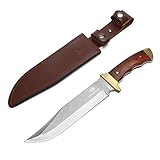
9. Mossy Oak 14-inch Bowie Knife, Full-tang Fixed Blade, Wood Handle Hunting Knife with Leather Sheath for Camping, Hiking, Survival
Overview:
This 14-inch Bowie knife features a full-tang 3CR13 stainless steel blade, rosewood handle, and genuine leather sheath. Targeting campers and survivalists, it balances traditional aesthetics with practical outdoor use, though explicitly not designed for chopping.
What Makes It Stand Out:
The classic rosewood handle with brass accents offers vintage appeal and a comfortable grip, while the leather sheath provides a timeless carry solution. Its clip-point blade excels at precision tasks, and the full-tang build ensures structural integrity.
Value for Money:
Well-priced for its materials (3CR13 steel and rosewood), but not a high-performance tool. It suits casual users seeking a reliable, attractive camp knife. Budget alternatives use cheaper steels, but this avoids the premium markup of professional-grade blades.
Strengths and Weaknesses:
Strengths: Elegant rosewood/brass design; comfortable grip; genuine leather sheath; decent corrosion resistance. Weaknesses: 3CR13 steel has modest edge retention; weight (14 oz) feels unbalanced for extended use; not suitable for heavy-duty tasks as warned.
Bottom Line:
A stylish, entry-level Bowie for light camp duties and collectors. Avoid for survival scenarios requiring toughness, but ideal for fair-weather adventurers wanting classic charm. Manage expectations around its performance limits.
10. Dispatch Fixed Blade Hunting Knife with Sheath, 12-inch Survival Knives for Men Tactical Bowie Knife with Non-Slip Handle for Bushcraft, Outdoor Camping

Overview:
The Dispatch 12-inch fixed blade is a tactical-style Bowie knife built for survivalists and campers. Featuring high-carbon stainless steel, a rubber handle, and a plastic-reinforced sheath, it targets users seeking a rugged, no-frills outdoor tool.
What Makes It Stand Out:
The aggressive rubber handle guarantees a non-slip grip in wet conditions, while the thick (0.12") high-carbon blade promises toughness. The heavy-duty nylon/plastic sheath includes a practical belt-hanging system, prioritizing field-ready durability.
Value for Money:
Competitively priced for its size and carbon steel construction. It outperforms similarly priced plastic-handled knives in grip security but lags behind premium steel blades in edge retention. Solid for the price if you prioritize grip and resilience over refinement.
Strengths and Weaknesses:
Strengths: Exceptional non-slip rubber handle; sturdy carbon steel blade; robust sheath with easy belt access; strong after-sales support. Weaknesses: Plastic-sheath feels cheap; carbon steel requires frequent maintenance; heavy (14.4 oz) limits EDC appeal.
Bottom Line:
A dependable, grip-focused workhorse for wet environments, though the sheath quality holds it back. Best for campers prioritizing reliability over elegance—avoid for backpacking due to weight, but great for base-camp survival.
Understanding the Unique Demands of Survival Hunting Knives
Survival scenarios demand far more from a blade than standard hunting or camping. This isn’t about precision skinning in a controlled environment; it’s about extreme versatility under duress. Your knife must perform heavy batoning tasks to split stubborn logs, withstand prying forces when constructing shelter, and maintain a functional edge after hours of processing wood and bone—often with limited or no opportunity for proper sharpening. It must be robust enough for life-saving tasks yet precise enough for delicate first aid or trap building. Recognizing this spectrum of potential uses is the first step toward selecting a tool built for reality, not just theory.
Why General Purpose Knives Fall Short
While multi-tools or standard pocket knives have their place, they lack the necessary strength, blade geometry, and ergonomics for sustained survival tasks. Folding mechanisms can fail under heavy lateral stress, blade steel is often too thin or brittle for batoning, and the small size becomes a liability when processing large game or building substantial shelter. A dedicated fixed blade, designed from the ground up for ruggedness and a wide range of cutting angles, is almost always the prudent choice for serious survival scenarios where failure isn’t an option.
The Critical Role of Context in Selection
Your specific environment and anticipated challenges dictate optimal knife characteristics. A survivalist navigating dense, wet Pacific Northwest forests needs different blade geometry and handle material considerations than someone preparing for the arid deserts of the Southwest or the frozen tundra. Factors like prevalent game size, typical wood density for shelter/fire, expected moisture levels, and even potential emergency medical needs must inform your choice. There is no universal “best”; only the best for your specific survival context.
Blade Geometry: Form Follows Function in the Wild
The shape of the blade isn’t just about looks; it fundamentally determines how the knife performs specific tasks critical to survival. Choosing the wrong geometry can turn a simple job into a grueling, inefficient chore, wasting precious energy and time.
Drop Point vs. Clip Point: Practical Applications
Drop points, with their robust, curved belly and strong, accessible tip, are often favored for survival hunting. The pronounced belly excels at skinning and general slicing, while the strong tip is less prone to breakage during piercing tasks like initiating batoning or puncturing hides. Clip points offer a finer, more acute tip useful for detailed work, but this tip is inherently weaker and more susceptible to damage under heavy prying or batoning stress—a significant risk factor in survival situations where blade integrity is paramount.
The Belly Curve: Balancing Versatility and Control
A moderate belly curve provides excellent slicing efficiency for skinning game and processing vegetation. However, an overly aggressive curve can hinder controlled push-cuts needed for precise wood carving or shelter construction. Look for a belly that offers a good slicing radius without sacrificing the ability to perform straight, controlled cuts when needed for notching poles or carving feather sticks. This balance is crucial for a knife intended for diverse survival tasks.
Point Geometry: Strength vs. Precision
The tip configuration is vital. A spear point offers excellent symmetry and piercing power but can be fragile. A trailing point provides a long, fine cutting edge ideal for skinning but sacrifices tip strength for heavy-duty work. For general survival hunting, a drop point with a reinforced tip (sometimes called a “hunter’s point”) typically provides the best compromise—sufficient piercing capability for initial hide penetration and field dressing, combined with the structural integrity needed for batoning and prying tasks without snapping.
Blade Steel: The Heart of Durability and Performance
The steel composition is arguably the most critical factor determining long-term performance and reliability. It dictates edge retention, ease of sharpening in the field, resistance to chipping, and corrosion resistance—factors that become life-or-death considerations when you can’t simply replace a dull or broken blade.
Edge Retention vs. Ease of Sharpening: The Survivalist’s Dilemma
High-carbon steels (like 1095) are renowned for their ease of sharpening with rudimentary tools (stones, files) and excellent toughness, resisting chips even under brutal use. However, they rust easily if neglected and lose their edge faster than premium stainless alloys. Modern stainless steels (like certain 400-series or specific high-end alloys) offer superior corrosion resistance and often better edge retention, but can be significantly harder to sharpen effectively with basic survival sharpeners and may be more brittle. For most survivalists, the ability to reliably put a functional edge back on the blade in adverse conditions often outweighs superior initial sharpness or retention.
Corrosion Resistance: A Non-Negotiable in Wet Environments
If your survival scenario involves frequent rain, immersion in water, or high humidity, corrosion resistance becomes critical. A blade that pits and rusts not only looks bad but can weaken structurally and become difficult to clean and maintain hygienically. While high-carbon steels require meticulous drying and oiling, stainless options offer peace of mind. However, prioritize steels known for practical corrosion resistance in survival contexts, not just lab-tested ratings; some “stainless” steels are far more resistant than others.
Toughness: Why Chipping is a Dealbreaker
Toughness refers to the steel’s ability to absorb impact and resist chipping or cracking. In survival, your knife will inevitably encounter hard materials—frozen ground, knotted wood, bone. A steel that chips easily renders the blade useless for critical tasks. Look for steels with proven toughness ratings. While often associated with carbon steels, several modern stainless alloys also offer excellent toughness. Avoid extremely hard, high-wear-resistance steels known for brittleness unless you have a specific, controlled use case; they are generally poor choices for the unpredictable demands of survival.
Handle Design: Grip is Everything When Stakes Are High
A blade can be forged from the finest steel, but if you can’t hold it securely with wet, bloody, or gloved hands, it’s useless. Handle design is paramount for safety and effectiveness in survival scenarios where a slip can mean injury or failure.
Ergonomics for Extended Use and Glove Compatibility
The handle must fit your hand comfortably for hours of sustained work, whether field dressing game or carving shelter components. Avoid overly sculpted handles that only fit one hand size or orientation. Look for designs with subtle contours that lock the hand in place during push cuts without causing hot spots. Crucially, ensure the handle accommodates thick winter gloves – a survival necessity in many environments. Test the grip with gloves if possible; a handle that feels perfect bare-handed might become unwieldy when protected.
Material Matters: Grip in All Conditions
Handle materials range from natural (micarta, G-10, stabilized wood) to synthetics (various polymers). Prioritize materials that maintain grip when wet, oily, or bloody. Micarta (especially linen-based) and textured G-10 are legendary for their non-slip properties in adverse conditions. Avoid overly smooth woods or certain plastics that become slick when wet. Consider also the material’s resistance to swelling (wood in rain) or extreme cold brittleness. Balance grip security with long-term durability and weight.
The Full Tang Debate: Strength vs. Weight
A full tang (where the blade steel runs the entire length and width of the handle, sandwiched by scales) is often touted as the gold standard for strength. While it provides excellent structural integrity for heavy batoning, it also adds significant weight. Many modern knives use strong partial tangs (like hidden tangs with robust epoxy/peening) that are lighter yet still sufficiently strong for realistic survival tasks. Don’t dismiss a well-constructed partial tang knife solely on tang philosophy; evaluate the actual construction quality and intended use. For most survivalists, a robust hidden tang or a well-executed partial tang offers the best weight-to-strength ratio.
The Essential Lifeline: Sheath Design and Carry Options
A knife is only as reliable as its sheath. A poor sheath makes the knife inaccessible, unsafe to carry, or vulnerable to damage. In survival, you need immediate, secure access and absolute confidence the blade won’t fall out during a scramble or get lost in the brush.
Secure Retention: Safety First, Always
The sheath must hold the knife firmly without requiring excessive force to draw, especially with cold or gloved hands. Loose retention leads to lost knives; overly tight retention can cause dangerous slips or delays in critical moments. Ideal retention is adjustable (via tension screws or straps) and consistent across various draw angles. Test the draw repeatedly – it should be smooth, predictable, and require consistent pressure. Never compromise on secure retention; a lost knife in the wild is a dire situation.
Material Choices for Durability and Stealth
Kydex offers excellent durability, consistent retention, and precise molding for a perfect fit. It’s largely impervious to weather and won’t absorb moisture. Leather is traditional, molds to the knife over time, and is quieter, but requires maintenance, can warp when wet, and retention can change with humidity. Nylon (like Cordura) is lightweight and tough but often lacks the precise retention of Kydex. Prioritize sheaths made from materials that won’t degrade quickly in your expected environment and offer reliable, weather-resistant performance.
Versatile Carry Configurations for Survival Mobility
How and where you carry the knife impacts accessibility and comfort during long treks. Belt carry (vertical, horizontal, or cross-draw) is most common. Consider if the sheath offers multiple mounting options (belt loop size, MOLLE compatibility, paddle attachments). Can it be reversed for left-hand carry? Is it comfortable when wearing a pack? For survival, prioritize a carry method that keeps the knife instantly accessible on your dominant side without snagging on vegetation or gear, yet secure enough to survive rugged movement. A knife you can’t reach quickly when needed is no knife at all.
Maintenance and Longevity: Ensuring Reliability When It Counts
A survival knife isn’t a collectible; it’s a working tool that must endure years of potential neglect followed by sudden, critical use. Design features impacting ease of cleaning, sharpening, and long-term resilience are vital.
Simplicity: Fewer Parts, Fewer Failures
Avoid knives with unnecessary moving parts, complex guards, or intricate handle constructions that can trap dirt, moisture, blood, or hair. These create hygiene hazards and potential failure points. A simple, smooth handle with minimal grooves, a straightforward guard (or none at all if the design allows safe use), and easily cleanable materials (like smooth micarta or G-10) ensure the knife can be kept functional and sanitary even with limited water and cleaning tools.
Ease of Field Sharpening: A Survival Imperative
Your chosen knife must be possible to sharpen effectively using the most basic tools you might carry or find: a simple stone, a piece of concrete, or even a smooth river rock. Consider the blade grind – flat grinds are generally the easiest to maintain consistently in the field compared to complex hollow grinds. Avoid blades with compound bevels or extreme angles that are difficult to replicate without specialized equipment. Test sharpening your potential knife with a basic stone; if it’s frustrating now, it will be disastrous when exhausted and cold.
Corrosion Prevention Features and Habits
Beyond steel choice, look for practical features: minimal internal voids in the handle where moisture can pool, smooth transitions between handle and tang to prevent dirt traps, and possibly a slight taper on the tang to shed water. However, the most crucial factor is developing the habit of drying and lightly oiling your knife after any exposure to moisture, especially saltwater. Carry a small rag and a tiny vial of oil (like mineral oil) as part of your core kit. Prevention is infinitely easier than trying to restore a heavily rusted blade in the field.
Real-World Testing: Beyond the Hype
Marketing claims mean little when you’re knee-deep in a survival scenario. Understanding how to evaluate a knife’s true potential requires practical assessment.
Simulating Survival Stress: Practical Evaluation Methods
Don’t just look at it; use it. Test batoning with green wood – does the blade drive cleanly through, or does it bind and require excessive force? Try carving a notched joint for shelter; is the tip precise and strong? Skin a carcass (or practice on hide); does the belly curve facilitate smooth motion? Subject it to controlled moisture exposure; does the handle remain grippy? These practical tests reveal far more than lab specs about how the knife will perform under real survival duress.
The Importance of User Feedback from Credible Sources
Seek out reviews and experiences from individuals who actually use knives in prolonged, off-grid survival scenarios or demanding hunting situations – not just tactical range testers or collectors. Look for feedback on long-term durability, real-world corrosion issues, handle comfort during extended work, and sheath reliability after months of hard use. Forums dedicated to traditional hunting, bushcraft, or long-term wilderness living often provide more relevant insights than mainstream gear review sites focused on short-term tactical use.
Understanding the “Why” Behind Design Choices
Before dismissing a feature (like the absence of a large guard or a specific steel choice), research why the maker chose that path. A minimalist guard might enhance carving control; a specific carbon steel might be chosen because it’s easily sharpened in the field with a file. Understanding the design philosophy helps you evaluate if it aligns with your survival priorities and potential scenarios, rather than judging based on preconceived notions or trends.
Integrating the Knife into Your Survival System
Your knife doesn’t operate in isolation. Its design should complement your other gear and planned survival strategies.
Synergy with Fire-Starting and Shelter-Building Kits
Consider how the knife interfaces with your fire kit. Can it efficiently carve feather sticks from damp wood? Does the spine provide a suitable striking surface for a ferro rod? For shelter building, assess its effectiveness at notching poles, lashing cordage (without damaging it), and processing green wood for structure. A knife that excels at skinning but struggles with wood processing creates an unnecessary bottleneck in your overall survival workflow.
Medical Preparedness: The Knife’s Role in First Aid
While not a primary medical tool, a survival knife can be critical for improvised first aid: cutting clothing away from wounds, fashioning splints, or preparing clean bandages from cloth. Ensure the blade design allows for controlled, precise cutting in tight spaces without excessive risk of slipping. A fine tip can be useful here, but balance it against the need for overall strength. Avoid serrated edges for medical tasks, as they cause ragged wounds.
The Psychological Factor: Trust in Your Tool
Beyond physical attributes, you need absolute confidence in your knife. When exhaustion sets in and conditions worsen, hesitation is deadly. Choosing a knife whose design, weight, and feel instill genuine trust – one you’ve tested rigorously and know intimately – provides an invaluable psychological edge. This trust is built through understanding its capabilities and limitations through hands-on use, not just on paper specs.
Frequently Asked Questions
Frequently Asked Questions
What’s the single most important feature for a survival hunting knife? Blade steel toughness combined with practical corrosion resistance is paramount. A blade that chips under batoning stress or rusts through during wet conditions is useless, regardless of other features.
Can I use a standard hunting knife for survival situations? Many standard hunting knives lack the robust construction, versatile blade geometry, and sheath security needed for demanding survival tasks like heavy batoning, shelter building, or emergency medical use. Dedicated survival-hunting hybrids are generally more suitable.
How important is blade length for survival hunting? A blade between 4 and 6 inches offers the best balance. It’s long enough for effective skinning and batoning smaller wood, yet short enough for precise carving and control. Longer blades become unwieldy for fine work and add unnecessary weight.
Should I prioritize a full tang for survival? While full tangs offer maximum strength, many well-constructed knives with robust hidden or partial tangs provide ample strength for realistic survival tasks while saving significant weight. Evaluate the actual construction quality, not just tang type.
Is a drop point or clip point better for survival? A drop point is generally superior. It offers a stronger, more accessible tip for piercing tasks (like initiating batoning) and is less prone to snagging or breaking compared to the finer, weaker tip of a clip point.
How do I test a knife’s grip security for survival use? Test the grip thoroughly with wet hands, wearing your typical work or winter gloves, and simulate chopping motions. The knife should feel locked in place without requiring a death grip, and there should be no tendency to rotate or slip during forceful push cuts.
Why is ease of field sharpening so critical for a survival knife? In a prolonged survival scenario, you won’t have access to a workshop grinder. Your ability to quickly restore a functional edge using only basic tools (a stone, file, or even concrete) is essential for maintaining the knife’s effectiveness for critical tasks.
What sheath feature is non-negotiable for survival carry? Secure, adjustable retention that holds the knife firmly yet allows for a smooth, predictable draw with gloves on is essential. A knife that falls out or is difficult to draw quickly is a major safety hazard.
Can a knife be too heavy for survival use? Yes. While robustness is needed, excessive weight becomes a burden over long distances. Aim for the lightest knife that still meets your required strength and functionality needs for the specific environment. Every ounce counts when carrying your life on your back.
Is stainless steel or carbon steel better for a survival knife? It depends on your environment. Carbon steel (like 1095) is easier to sharpen in the field and tougher, but requires diligent maintenance to prevent rust. Stainless offers better corrosion resistance but can be harder to sharpen and may be more brittle. Prioritize ease of field maintenance if reliability in adverse conditions is your top concern.
Related Buying Guides
- The 10 Best Hunting Gloves Every Survivalist Needs This Year
- Top 10 Best Hunting Boots for Cold Weather Survival in 2026
- Top 10 Best Hunting Jackets for Cold Weather Survival in 2026
- Top 10 Best Tactical Flashlights for Night Hunting in 2026
- 10 Best Value Waterproof Flashlights for All-Weather Hunting in 2026